The Magician Formula
Note
This text is excerpted from an essay written by Melita Denning in 1973, as a preface to a Llewellyn catalogue on ceremonial magic. Issued as a supplement to Gnostica magazine, to which she and Osborne Phillips contributed many articles, it is unlikely many of its initial readers grasped its full depth. A number of the pieces for Gnostica are worth retrieving from obscurity for their insights into magical practice in our tradition.
This section concerns the formula called The Magician, a powerful form of divine magic (‘theurgy’) used very frequently by our initiates. The formula – that is, the skeleton of the rite – can be read in Mysteria Magica, which had yet to be issued at the time this was written. It is the first of the great Formulae of the House of Sacrifice the initiate encounters. Each must build their own version of the working from that skeleton text. We offer this excerpt as a good taster of our work, and a helpful guide for those approaching The Magician for the first time.
As will be understood by the discerning reader, The Magician is essentially a ‘virtuous cycle’ ritual. That is, it uses the individual’s magical capacity (built up through the foundational techniques) to align, deepen and expand that very magical capacity – a cycle to be repeated in the following iterations of the ritual. From one perspective, it is like pulling yourself up by your magical bootstraps. Even for adepts of our tradition, it remains a useful technique.
Rites for Personal Use
At the same time, besides this salutary effect of the different kinds of ceremonial magic, it should be added that there are some rites for personal use, which act more directly in maturing the psyche. A particular AS formula is especially noteworthy here, which operated inwardly in a distinctive manner: The Formula of the Magician. As we say in words of aspiration taken from Parmenides, a Greek mystical poet of the fifth century before the common era:
Hastening the chariot of my heart’s desire
My Goddess-guided powers have carried me
To find that inner road, that glorious road
Known to the wise. Hast thou not burned, my soul? –
Yea, chariot-wheels almost to flame aglow –
Seeking for my longed-for goal, the home of Truth?
From the Gates of Night I have come to the sill of Day,
I have passed the Brazen Door.
She has grasped my hand –
The Goddess, my Queen –
And has bidden me still seek Truth on the inward road
of Knowledge, while Opinion roams the world.
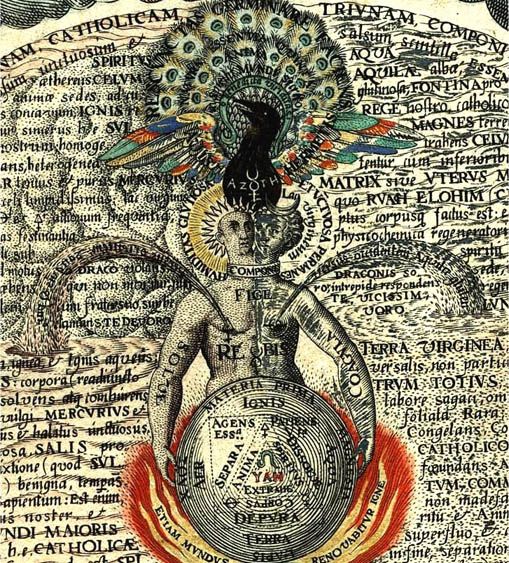
The action of The Formula of the Magician begins, after the utterance of this hymn, with the magician standing motionless in the Tau posture, attention fixed in contemplation of his Corona Flammae, and the microcosmic Kether centre situated above his head. Awe and wonder fill this contemplation, for its object is that Bud of Light, that particular nucleus in the Divine Mind, from which the individual psyche itself has been projected into the worlds where it has come to manifestation.
This first phase having been concluded with suitable action which is specified in the Formula, the magician next celebrates in a powerful and lofty chant his Triune Neshamah, the microcosmic presence of the Three Supernals conjunct within his psyche. The Neshamah, strictly speaking, corresponds to the Sphere of Binah, but only from a very high viewpoint does this distinction have significance. The Triune Neshamah comprises, besides the Kether-flame, those other two functions within the psyche which are too elevated to come within the range of consciousness, which correspond to the Sephiroth Chokhmah and Binah and which in the psyche are denoted as Animus and Anima, the sacred sources of maleness and femaleness, the inner Father and Mother of the personality. These two, with that flame which is their origin, remain apart within the inmost shrine of the psyche, waiting for the conscious mind to make itself a meet and willing receptacle for their influence.
The most likely motive to set it on the way is a glimpse caught indirectly of one of the Three, reflected somewhere among the myriad shining facets of the outer world, and endowing that facet which reflects it with a quality of fascination, of inspiration, uniquely felt and responded to by the particular beholder. For some, it is the maleness of Chokmah seen in reflection which fascinates and inspires; for others, it is the female quality of Binah; for others again, a minority who are destined to be marked out as mystics from the beginning; it is the supreme flame of Kether, whether reflected in the star-firmament of humanity or in the total luminosity of the whole natural universe.
These three Supernals of the psyche, not as reflected beyond the sanctuary of the inner self, but as their august and unseen realities within that sanctuary, the magician at this time celebrates. The tone, although sublime, must here be filial, joyous, and intimate: these Supernals are not “out there” in the material inaccessibilities beyond the light of our Sun; they are not even in the comparatively imaginable heights of a god-filled Empyrean; they pertain to the Magician himself and to no other person in the unjverse, by inalienable right, and they await his coming and his laying claim to that spiritual heritage which is like no other and which is to be his alone.
Blessing Toward Lower Nature
The next section of the formula is devised to express loving care, blessing and well-wishing toward the lower nature and the physical body, addressing it as a wayward but dear child, as an old friend, as younger brother or sister to the rational mind, as the magician may feel to be suitable. The sincere performance of this is most important for the success of the rite, and calls for a truly magical understanding on the part of the utterer. One feels a tender sense of responsibility and of concern for a child, or for an animal, which may be in one’s care, and this feeling is right: the destiny of the other being is bound up with one’s own; its happiness and its entire future depend on one’s decisions, and these decisions may, as a simple fact, have to take other considerations into account besides that precious life. It is a grave matter, but at least it is mitigated, or ought to be mitigated, by one’s having weighed one’s capabilities and the conditions of one’s own life before taking on a further responsibility of that kind.
In the case of one’s own lower nature and the physical body, the matter stands rather differently, in some ways. lt is not, as some old-fashioned writers have mistakenly put forward, that these lower levels ought to be regarded as hostile to our life’s high spiritual purpose, as if any guilt that the rational self might incur, any error in decision-making, must be considered the responsibility of a lower self always trying to drag us down to the depths. That is nonsense. Anyone who has returned in full consciousness from an astral journey, and who has beheld his or her physical body lying unconscious, animated by the faithful instinctual life that has kept heart beating and lungs breathing, anyone who has looked with compassion on that mute and unquestioning companion, incapable in itself of a single rational thought or effective decision, must know where all responsibility lies.
A difficulty, of course, may be the fact that we generally have no recollection of the time before this incarnation when we decided (if we decided) we were equipped and willing to take responsibility for the destiny of a human animal, body, instincts, and emotions; nevertheless, the responsibility is ours, and the bond between the rational and the lower nature ought to be a true bond of love. In this spirit, then, the magician is to address his lower self, to give it reassurance and trust for what is to follow. He then turns again to the Triune Neshamah, giving it thanks insofar as this may be possible for all circumstances relating directly or indirectly to the present incarnation. Any of these circumstances which may be considered adverse should be included with the rest, since all have been needful to bring the present into being exactly as it exists. He should, as far as it is possible, identify with the Neshamah and his True Will. Now comes the critical act of the rite.
The magician proceeds, by a particular technique, to eject Nephesh material (the material of which the astral body is composed) and with this builds up in his visual imagination a life-size simulacrum of himself, standing facing him. He now addresses this simulacrum, which is thus not a merely feigned image, but a true representative of his own astral nature, of his instinctual and emotional self. Whatever admonitions, preferences, commands, the magician voices to this simulacrum will not be lost, but all should be expressed in simple and direct language, as to a voung one, and most important, all in terms and tones of love. When this phase of the work is concluded, having blessed the simulacrum in the name of his Higher Self, the magician performs another ritual act to seal, to confirm as it were, his message within the simulacrum. He then re-absorbs the simulacrum into the living substance of his astral body.
There is less need here to give the full formula because it, with numerous others for widely differing purposes, will appear in all requisite detail in Mysteria Magica, Book V of The Magical Philosophy. The purpose in here outlining this psychosophical formula is to illustrate the way in which ceremonial work can be employed by the magician to contribute, not merely incidentally but with complete deliberation toward his inner progress.
The Joy of Magic
The slow but continual effect of ceremonial work generally, in gradually laying open to consideration the individuality of the magician at every level, with the aid of the Magical Personality (until this itself is wholly assimilated) in counteracting imbalances, is an exhilarating and, overall, a joyous experience. It ceaselessly draws the magician on to further effort just as, in physical matters, youngsters love the games that turn them from pudgy children to lithe adolescents. Even as they leap and run, delighting in the games themselves and then in the transformation which gradually takes place in the players, so does the magician delight frankly and truly in the marvels, the beauty, the strange contexts and triumphs, the sure knowledge and incommunicable experiences that come in the course of ceremonial work. Yet at the same time, he keeps sight of the ultimate purpose, for always, even in the conscious mind, there is something which maintains contact with that goal, which winds tightly around the wrist even in moments of highest excitement or peril the saving thread that leads through the Labyrinth; it is something which distinguishes between pleasure and bliss, between wonderment and ekstasis, between the insatiable and the beyond-tears yearning of Yesod and the stark desolation of Binah. The magician’s business is to experience, to learn, to grow in stature, and not to linger.